
Atomic Habits
The Brutal Truth About Why Your Life Isn’t Changing
Most people try to change their life like they are filming a comeback trailer. New year, new me, new routine, new gym shoes, new water bottle, and one motivational song playing like they are about to conquer Wall Street. For three days, everything feels powerful. Then suddenly, they are back in bed at 1:47 AM, scrolling reels and eating something they promised themselves they would never touch again.
That is where Atomic Habits by James Clear becomes useful. This book does not scream at you like a fake guru. It does not tell you to wake up at 4 AM, take a cold shower, build a company before breakfast, and become rich by lunch. Thankfully. It gives a smarter and more realistic idea: “your life does not change because of one huge decision. It changes because of small actions repeated every day.”
James Clear calls them “atomic habits” because they are tiny but powerful. Alone, they look small. Repeated long enough, they can rebuild your whole life. The main lesson is simple: stop obsessing over goals and start fixing your system. Because everyone has goals. The unhealthy person wants fitness. The broke person wants savings. The distracted person wants focus. The writer wants to write. The student wants better grades. Wanting is not the problem.
The problem is living inside the same system that created your old results while expecting a new life. That is like spilling coffee on your shirt every morning and blaming the shirt. Atomic Habits teaches that change is not about becoming superhuman. It is about making good habits easier, bad habits harder, and your environment less stupid.
Most of us do not need more motivation. We need fewer traps, fewer distractions, and fewer “I will start Monday” speeches. This book shows how tiny changes, repeated consistently, can rebuild your identity, discipline, confidence, health, and future. Not overnight. Not magically. Realistically. So.. let’s dive in.

One of the biggest lessons in Atomic Habits is simple: Small habits look weak in the moment, but they become powerful when repeated. That is the annoying part about self-improvement.
You drink one glass of water, and nothing magical happens.
You read one page, and your brain does not suddenly become a library.
You do ten push-ups, and your body does not say, “Congratulations, we are now an athlete.”
So people quit. They think, “This is not working.”
But James Clear explains that habits work like compound interest. One small action may look useless today, but repeated daily, it starts building a different future.
This is the famous 1% better every day idea. At first, 1% sounds almost insulting. Nobody throws a party because you improved your life by 1% today.
But that is the trick. Real change usually looks boring at first.
The workout looks small.
The saving looks small.
The reading looks small.
The discipline looks small.
But small does not mean weak.
You do not become unhealthy because of one burger. You become unhealthy because poor eating becomes normal. You do not become distracted because you checked your phone once. You become distracted because your phone became the boss and you became the unpaid intern.
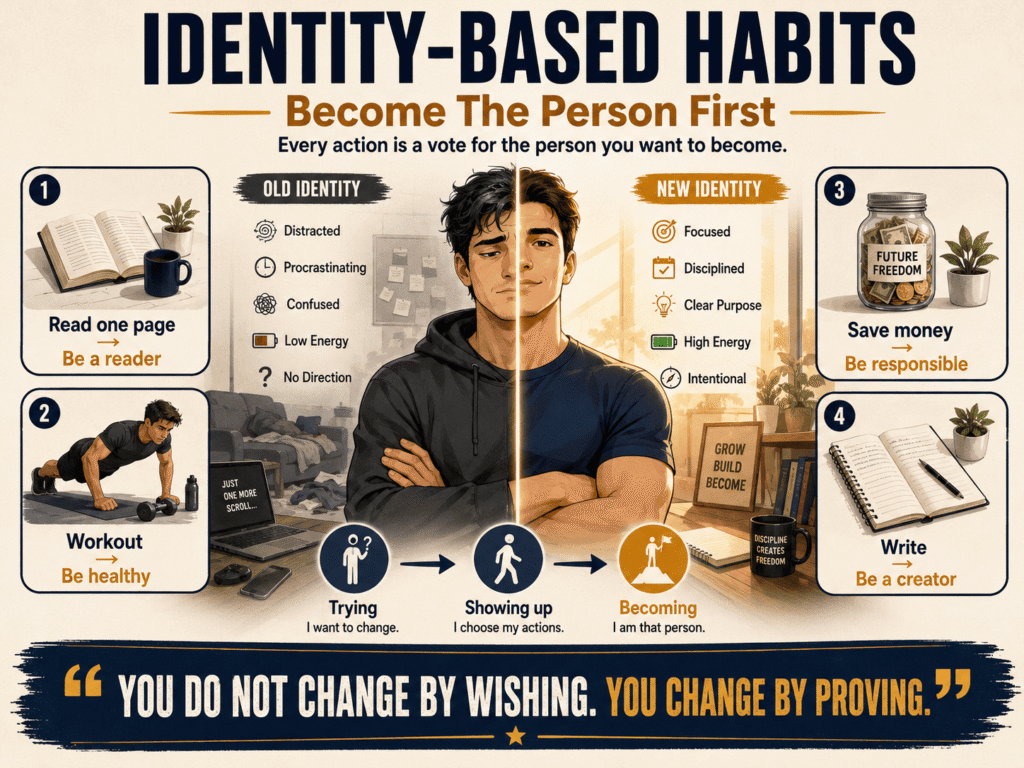
A habit is like a vote.
Read one page? Vote for being a reader.
Work out for ten minutes? Vote for being healthy.
Save a little money? Vote for being responsible.
Write one paragraph? Vote for being a creator.
One vote does not decide the election. But enough votes do.
That is the real lesson: do not chase one giant transformation. Chase the small action you can repeat. Because after enough repetition, the small action stops being small.
It becomes your routine. Then your identity. Then your life.
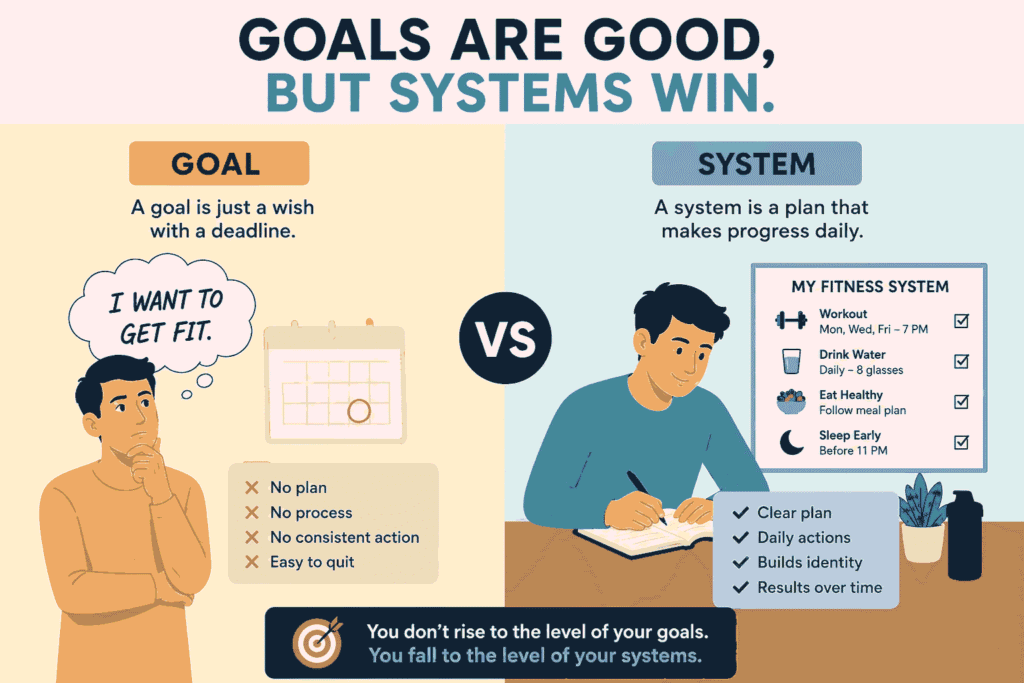
Most people love goals because goals sound impressive. “I want to lose weight.” “I want to become rich.” “I want to write a book.” “I want to become disciplined.”
Beautiful. Powerful. Very LinkedIn-friendly. But James Clear makes a sharper point in Atomic Habits: Goals are good for direction, but systems are good for progress.
Because almost everyone has goals. The person who gets fit has a goal. The person who quits after four days also had a goal. So the goal is not the real difference. The system is.
A goal says, “I want to be fit.”
A system says, “I work out every Monday, Wednesday, and Friday at 7 PM.”
A goal says, “I want to save money.”
A system says, “I move money into savings right after payday.”
A goal says, “I want to write more.”
A system says, “I write 300 words every morning before checking my phone.”
A goal is a wish with confidence. A system is a plan with legs. Most people keep upgrading the dream but never upgrade the daily routine.
They buy the gym shoes. Download the productivity app. Watch five videos on becoming “that person.” Then morning comes, the phone rings, work starts, mood drops, someone sends a meme, and the life transformation is postponed to next Monday. That is why systems matter.
A good system does not ask you to feel inspired every day. It simply makes the right action easier.
Maybe you do not need more willpower. Maybe you need to keep your phone outside the room. Maybe you do not need a bigger dream. Maybe you need a fixed writing time. Maybe you do not need another motivational video. Maybe you need to stop buying snacks that attack you at 11 PM.
A better life is not built by dramatic promises. It is built by boring systems that protect you from your weaker moments. The lesson is simple:
Stop only setting goals. Start designing the daily system that makes those goals almost unavoidable.
This is where Atomic Habits stops being just a habit book and starts getting personal. Not in a dramatic “your life is falling apart” way, but in that sharp, uncomfortable way where the truth walks into the room, sits down, and says, “We both know what is going on here.”
James Clear says most people try to change by focusing on what they want to achieve. They say, “I want to lose weight,” “I want to read more,” “I want to become successful,” or “I want to be disciplined.” And those are good goals. Nothing wrong with them. But they are not deep enough. Because wanting a better result while still seeing yourself as the same old person is like changing your outfit and pretending your whole personality got upgraded.
The deeper question is not, “What do I want to achieve?” The deeper question is, “Who do I want to become?” That is where real change begins. Because if you want to get fit but still believe you are lazy, your mind will keep dragging you back to the old version. If you want to save money but keep telling yourself you are bad with money, every small mistake will feel like proof. If you want to write but keep saying, “I am not really a writer,” then congratulations, you have already built the excuse before opening the document.
Clear’s idea is simple: habits are not just actions. Habits are proof. Every time you do something, you give your brain evidence about who you are. When you read one page, you are not just reading. You are voting for the identity of a reader. When you work out for ten minutes, you are voting for the identity of someone who takes care of their body. When you save money instead of wasting it, you are voting for the identity of someone who respects their future.
One vote will not change everything. Nobody does five push-ups and suddenly becomes Captain Discipline. But repeated votes matter. Slowly, your brain starts collecting evidence. At first, you say, “I am trying to work out.” Then it becomes, “I work out sometimes.” And one day, without background music or a dramatic rain scene, you say, “I am someone who trains.” That is identity change. Not through speeches. Not through fake confidence. Through repeated proof.
And this is where it gets harsh. If you say you want success but your phone gets your best hours, your habits are not confused. You are. Your mouth is saying one thing, but your routine is voting for something else. You say you want peace, but keep entertaining drama. You say you want health, but treat your body like a rented scooter. You say you want growth, but avoid every uncomfortable thing that would actually grow you.
That is not a motivation problem. That is an identity conflict. You are trying to become a new person while still negotiating with the old one. And the old one is persuasive. It says, “Start tomorrow.” It says, “Just one more video.” It says, “You deserve this snack.” Very emotional. Very dramatic. Completely useless.
The solution is not to argue with the old identity. The solution is to build proof against it. Do not wait until you feel disciplined. Do one disciplined action. Do not wait until you feel like a writer. Write one paragraph. Do not wait until you feel confident. Keep one promise to yourself. Confidence is not something you magically download. It is built when your actions finally start matching your words.
So the better question is not, “How do I reach my goal?” The better question is, “What would the person I want to become do right now?” Would a healthy person order this? Would a focused person open this app? Would a serious creator skip today? Would a financially responsible person buy this just because they are bored?
That question is annoying because it removes excuses. But it also gives power back to you. Because every small action becomes a chance to prove who you are becoming.
The lesson is: you do not change your life by pretending to be a new person. You change it by giving yourself daily proof that the new person is real.
The first law of behavior change in Atomic Habits is simple: make it obvious. It sounds almost too basic, like James Clear walked into the room and said, “If you want to drink more water, keep water near you,” and everyone just sat there realizing they had been losing to a bottle.
But that is the point. Most people make their good habits invisible and their bad habits extremely available. They say they want to read more, but the book is buried under old papers, random chargers, and emotional damage. They say they want to work out, but their shoes are hidden in a cupboard like government evidence. They say they want to eat healthy, but the fruit is trapped in the fridge drawer while the chips are standing in front like they pay rent.
Then they say, “I have no discipline.” No. Your environment is just running a better campaign than your goals.
James Clear explains that habits start with cues. A cue is something that reminds your brain to act. Phone on the bed? Cue to scroll. Chocolate on the table? Cue to eat. Book on the pillow? Cue to read. Workout clothes beside the bed? Cue to move. You are not always choosing your habits consciously. A lot of the time, your surroundings are making the first move.
That is why making good habits obvious matters. It removes the need to depend on memory, mood, or motivation. Want to drink more water? Keep a bottle on your desk. Want to read before sleeping? Put the book on your pillow. Want to exercise in the morning? Keep your workout clothes ready at night. Want to write daily? Keep your notebook open where you work.
This is not about becoming a productivity robot. It is about making the better choice easier to notice. Because here is the harsh truth: if your good habits are hidden, they will lose. Your brain likes the obvious option. The easy option. The option already in front of it. So if Instagram is one tap away and your book is in another room, do not act shocked when Instagram wins. That is not weakness. That is bad design.
Good habits need visibility. Bad habits need distance. That is the simple game.
Clear also talks about using a specific plan. Not a weak plan like, “I will work out more.” That plan has no spine. Say, “I will work out at 7 PM in my room for 20 minutes.” Now your brain knows what to do, when to do it, and where to do it. Vague habits die quickly. Clear habits at least have a fighting chance.
Another useful method is habit stacking. You attach a new habit to something you already do. After brushing your teeth, drink one glass of water. After making tea, read two pages. After dinner, plan tomorrow. After sitting at your desk, write for ten minutes. You are using an old habit as the hook for a new one.
That is the smart move. Not more pressure. Better placement.
Motivation says, “I hope I remember.” A system says, “You will see it.”
The lesson is simple: stop hiding the person you want to become. Put the book where your hand can reach it, the water where your eyes can see it, and the phone where it cannot bully your attention. When the right habit becomes obvious, starting becomes easier. And when starting becomes easier, consistency becomes possible.
This is where most people ruin their own progress. They finally decide to change their life, and instead of starting small, they build a routine that looks like it was designed by a Navy SEAL, a monk, and a toxic productivity influencer in the same room.
Wake up at 5 AM. Meditate. Run. Read 50 pages. Eat perfectly. Work deeply for eight hours. Sleep like a baby. Repeat forever.
Beautiful plan. Completely illegal for a normal human being with bills, cravings, emotions, and a phone.
James Clear’s third law is simple: make it easy. Not impressive. Not perfect. Easy. Because the harder a habit is to start, the easier it is to avoid. Most people do not fail because change is impossible. They fail because they make the starting line too far away.
This is where the Two-Minute Rule matters. Clear’s idea is that when starting a new habit, shrink it until it takes two minutes or less. “Read every night” becomes “read one page.” “Work out daily” becomes “put on workout clothes.” “Write every day” becomes “write one sentence.” The point is not that one page will change your life. The point is that one page keeps the habit alive.
Your ego will hate this because your ego wants a dramatic transformation by Monday. But your future does not care about your dramatic announcement. Your future cares about what you can repeat.
A beginner does not need a heroic routine. A beginner needs a low-friction routine. Because the first goal is not intensity. The first goal is consistency.
If the habit feels too big, your brain starts negotiating. “I will do it later.” “I need more energy.” “I should wait for the perfect time.” Suddenly your brain becomes a lawyer for laziness.
But when the habit is tiny, excuses look stupid. You cannot seriously say, “I do not have time to read one page.” You can try, but even your own brain will be embarrassed.
The lesson is: do not build habits that impress people. Build habits you can actually repeat.
Here is the cruel joke about good habits: the reward usually arrives late. You work out today, but you do not get abs by dinner. You save money today, but your bank account does not suddenly start behaving like a billionaire’s diary. You read ten pages, but nobody invites you to give a TED Talk with soft lighting and dramatic pauses.
Bad habits are different. They pay fast. Junk food gives pleasure now. Scrolling gives entertainment now. Skipping work gives comfort now. Buying useless things gives a tiny thrill now. Then later, the bill arrives with interest and a very disrespectful attitude.
That is why James Clear’s fourth law is make it satisfying. Your brain likes immediate rewards. It does not care that “future you” will be grateful. Future you is not in the room. Present you is sitting there saying, “Nice speech, but where is my payment?”
This is where habit tracking becomes powerful. When you cross a day on a calendar, tick a box, move a paper clip, or keep a streak alive, your brain gets immediate proof that the action happened. It is not the final result, but it is a small reward. And small rewards matter because they help your brain say, “This felt good. Let’s do it again.”
The mistake most people make is that they only respect the final outcome. They check the mirror, the scale, the bank account, the follower count, or the test result. If the result is not big enough, they think nothing is working. That is how people quit too early. They ignore the action because the outcome has not caught up yet.
So do not only track results. Track the behavior. Did you work out today? Win. Did you write today? Win. Did you save money today? Win. Did you avoid scrolling before sleep? Win. The step matters before the mountain moves.
Clear also gives a simple rule that sounds gentle until it exposes you: never miss twice. Missing one day is normal. Life happens. Work gets messy. Your mood disappears like it owes someone money. Fine. Miss one day. But do not miss two. One missed day is an accident. Two missed days is your old identity trying to move back in with luggage.
The goal is not perfection. The goal is recovery. You are not trying to become a robot. You are trying to become the kind of person who returns quickly after slipping.
The lesson is simple: what feels immediately rewarding gets repeated. So make your good habits feel like small wins, not unpaid labor.
Most people talk about willpower like it is some magical muscle. “I just need more discipline.” “I just need more self-control.” “I just need to stop being weak.” Fine. Very dramatic. Almost cinematic.
But if your phone is beside your bed, snacks are on the table, Netflix is already open, and your desk looks like a crime scene, discipline is not the only problem. Your environment is quietly sabotaging you while your goals are giving motivational speeches in the corner.
James Clear makes this point clearly in Atomic Habits: behavior is shaped by context. You are not always making wise, independent decisions like a calm philosopher in a library. Sometimes you are just reacting to what is visible, easy, and close.
If cookies are on the table, you eat cookies. If your phone is beside your bed, you scroll. If your book is across the room under three random objects and one emotional crisis, you probably will not read. This is not always a character flaw. Sometimes your environment is just a trap wearing furniture.
Clear uses the Vietnam heroin example to show how powerful environment can be. Many soldiers who used heroin in Vietnam stopped after returning home because the cues, stress, and surroundings changed. The point is not that responsibility disappears. The point is that habits are deeply connected to environment, cues, and context.
So stop acting like you can win every fight through heroic self-control. The smarter move is to remove unnecessary fights. People with strong habits are not always stronger. Often, they simply put themselves in fewer stupid situations.
Want to stop eating junk? Do not keep junk food at home. Want to sleep better? Keep your phone away from your bed. Want to read more? Keep the book visible. Want to focus? Clean your desk before you work. Want to save money? Delete shopping apps and remove saved cards.
This is not weakness. This is design.
Your brain usually chooses the easiest available option. So make the good option easy and the bad option annoying. Put workout clothes where you can see them. Keep water on your desk. Put the book on your pillow. Block distracting apps. Make your workspace boring enough to actually work in.
The harsh truth is this: if your surroundings support your bad habits, your motivation will keep getting mugged. You can give yourself the best speech at night, but if you wake up in the same setup with the same triggers, the old life is waiting like, “Welcome back, champ.”
The lesson is simple: do not depend on heroic discipline. Design your environment so discipline has less work to do.
This part of Atomic Habits is uncomfortable because it makes you look at your people. And sometimes the answer is not cute.
James Clear explains that humans copy the habits of the close, the many, and the powerful. In simple words, we copy people we spend time with, people who feel normal around us, and people we admire. That means your social circle is not just “vibes.” It is training.
If everyone around you wastes money, wasting money starts looking normal. If everyone eats badly, bad eating becomes casual. If everyone complains but never acts, complaining starts sounding like a personality. But if everyone around you trains, reads, builds, saves, and improves, growth starts feeling normal.
That is the point: your group quietly teaches you what is acceptable.
This is why becoming disciplined is hard in a group that treats discipline like betrayal. You say, “I am sleeping early.” They say, “Bro, you changed.” You say, “I am saving money.” They say, “You are boring now.” You say, “I am working on myself.” They say, “Who do you think you are?”
Translation: “Please stay the same so I do not feel uncomfortable.”
That is not friendship. That is emotional kidnapping with snacks.
Clear uses the story of Laszlo Polgar and his daughters to show how culture shapes behavior. Polgar built a home environment around chess, and his daughters grew up with chess as a normal part of life. They became exceptional players, with Judit Polgar becoming one of the strongest female chess players in history. The point is not to turn your house into a chess laboratory. Please do not terrify your family. The point is that when a behavior becomes normal in your environment, it becomes easier to repeat.
If reading is normal, you read. If fitness is normal, you train. If building is normal, you build. If discipline is normal, you stop treating basic responsibility like a heroic sacrifice.
This does not mean you should become arrogant and cut everyone off because they are not “high-value” enough. That kind of thinking becomes self-help cosplay very quickly. You are not the CEO of human worth.
The point is awareness. You can love people and still limit how much their habits influence your future. Some people are great for laughter but terrible for direction. Some people are kind but chaotic. Some people are loyal but stuck. Some people are fun, but every time you hang out, your goals quietly leave the room.
The lesson is simple: choose a culture where your desired behavior is normal. The right circle makes discipline easier; the wrong circle makes excuses feel like home.
Building good habits is one side of the game. Breaking bad habits is the other. And this is where people lie to themselves like professional actors.
They say, “I want to stop scrolling,” while holding the phone. They say, “I want to eat clean,” while the house has enough snacks to survive a national emergency. They say, “I want to stop wasting money,” while every shopping app is logged in, card saved, notifications on, whispering, “You deserve this.”
No, you do not deserve another useless thing because you survived Wednesday.
James Clear’s method is simple: reverse the Four Laws. To build a good habit, make it obvious, attractive, easy, and satisfying. To break a bad habit, make it invisible, unattractive, difficult, and unsatisfying.
Bad habits survive because they are convenient. They are visible. They are attractive. They are easy. They are satisfying. So stop treating them like mysterious demons. They are not mysterious. They are well-designed.
Your phone is not addictive by accident. Junk food is not tempting by accident. Shopping apps are not smooth by accident. Social media does not keep going forever by accident. These things remove friction. So your job is to add friction back.
Want to stop scrolling at night? Keep your phone outside the bedroom. Want to stop eating junk? Stop bringing junk home like you are sponsoring your own downfall. Want to stop wasting money? Delete shopping apps and remove saved cards. Want to stop procrastinating? Open the document, write the first sentence, and make the next step impossible to misunderstand.
Bad habits hate friction. Make them annoying. Make them inconvenient. Make them less rewarding. Make them cost something.
A bad habit becomes dangerous when it is one tap away, one reach away, one click away, one excuse away. Right now, many people have built a VIP highway to their worst behaviors and then act shocked when they keep visiting.
The goal is not to become perfect. The goal is to make your worst habit less automatic. Because once a bad habit becomes harder to repeat than the better choice, it starts losing power.
Also, measure the habit honestly. “I only scroll a little” sounds cute until screen time shows five hours. “I do not spend much” sounds believable until the bank statement pulls out the evidence. “I eat okay” sounds fine until you track one week and the truth appears with fries.
Do not shame yourself. But do not protect your delusion either.
The lesson is simple: stop trusting willpower around habits designed to beat willpower. Make bad habits difficult, boring, and costly.
10. The Plateau Of Latent Potential — Progress Is Quiet Before It Gets Loud
This is one of the most important ideas in Atomic Habits because it explains why people quit too early. James Clear calls it the Plateau of Latent Potential. In normal language, it means you are improving, but life is not giving you a receipt yet.
You work out for two weeks and the mirror says, “Interesting. Nothing.” You write for a month and the audience says, “Who are you?” You save money and the bank account says, “Cute.” You study and the result says, “Please continue suffering.”
So people quit. They think, “This is not working.”
But often, it is working. It is just not visible yet.
Clear explains this with the ice cube example. Imagine an ice cube in a cold room. The temperature slowly rises from 25 degrees to 26, 27, 28, 29, 30, 31. Nothing seems to happen. Then at 32 degrees, the ice begins to melt. The final degree looks magical, but it only worked because of all the degrees before it.
That is how habits work. The breakthrough is not one moment. It is many invisible moments finally becoming visible.
This is where most people lose. They can handle the exciting beginning. New plan. New notebook. New app. New motivation. Very cinematic. They can also imagine the result. Better body. Better money. Better confidence. Better career. Very beautiful.
But between the beginning and the result is a long, ugly hallway called consistency.
No applause. No fast results. No dramatic music. Just repetition. That is where your old self starts whispering, “Maybe this is not working. Maybe stop. Maybe order food and think about life tomorrow.”
Very persuasive. Very useless.
The harsh truth is this: most people do not fail because they are incapable. They fail because they cannot survive the gap between effort and reward. They want the harvest before the roots. But life does not work like that.
When you read and do not feel smarter, keep reading. When you work out and do not look different, keep training. When you write and nobody cares, keep writing. When you save and the amount feels small, keep saving.
The lack of visible results does not always mean failure. Sometimes it means you are still below the surface.
The lesson is simple: do not quit during the invisible stage. Most breakthroughs look sudden because nobody saw the quiet work that created them.
11. The Goldilocks Rule — Not Too Easy, Not Too Brutal
Another reason people fail is that they choose the wrong level of difficulty. Some make habits too easy for too long and get bored. Others make habits too hard too fast, collapse emotionally, and call it “self-care.”
James Clear explains the Goldilocks Rule: humans stay motivated when a task is not too easy and not too hard, but just challenging enough to stay interesting.
If a task is too easy, your brain says, “This is boring.” If it is too hard, your brain says, “This is abuse.” But if it is slightly beyond your current ability, your brain wakes up. That is where growth happens.
This applies to almost everything.
If you are new to fitness, do not start with a workout that makes stairs feel like legal punishment. Start where you are. But do not stay at two push-ups forever if your body can do more. At some point, you need progression.
If you are trying to write, do not demand 3,000 perfect words on day one like you are being chased by a deadline and shame. Start with something you can repeat, then raise the standard.
If you are trying to read, do not start with the hardest philosophy book in human history just to feel deep while understanding nothing. Start with a book that keeps you interested, then level up.
The goal is to keep the habit alive and improving. Not dead from boredom. Not dead from pressure. Alive.
This is where people misunderstand consistency. Consistency does not mean doing the exact same thing forever. Consistency means showing up and adjusting the challenge as you grow. Beginners need easy starts. Intermediate people need challenge. Advanced people need refinement.
A beginner trying an advanced routine is not discipline. It is walking into the wrong classroom and crying because the exam is hard. Calm down. You are in chapter one trying to take the final test.
On the other hand, staying in beginner mode forever is also a problem. Showing up is good, but showing up is the entry ticket, not the entire concert. At some point, you need to raise the standard just enough.
That is the Goldilocks zone: not too soft, not too brutal, slightly challenging.
The lesson is simple: make the habit easy enough to repeat, but challenging enough to respect. Growth lives between comfort and chaos.
This is one of the most important ideas in Atomic Habits because it explains why people quit too early. James Clear calls it the Plateau of Latent Potential. In normal language, it means you are improving, but life is not giving you a receipt yet.
You work out for two weeks and the mirror says, “Interesting. Nothing.” You write for a month and the audience says, “Who are you?” You save money and the bank account says, “Cute.” You study and the result says, “Please continue suffering.”
So people quit. They think, “This is not working.”
But often, it is working. It is just not visible yet.
Clear explains this with the ice cube example. Imagine an ice cube in a cold room. The temperature slowly rises from 25 degrees to 26, 27, 28, 29, 30, 31. Nothing seems to happen. Then at 32 degrees, the ice begins to melt. The final degree looks magical, but it only worked because of all the degrees before it.
That is how habits work. The breakthrough is not one moment. It is many invisible moments finally becoming visible.
This is where most people lose. They can handle the exciting beginning. New plan. New notebook. New app. New motivation. Very cinematic. They can also imagine the result. Better body. Better money. Better confidence. Better career. Very beautiful.
But between the beginning and the result is a long, ugly hallway called consistency.
No applause. No fast results. No dramatic music. Just repetition. That is where your old self starts whispering, “Maybe this is not working. Maybe stop. Maybe order food and think about life tomorrow.”
Very persuasive. Very useless.
The harsh truth is this: most people do not fail because they are incapable. They fail because they cannot survive the gap between effort and reward. They want the harvest before the roots. But life does not work like that.
When you read and do not feel smarter, keep reading. When you work out and do not look different, keep training. When you write and nobody cares, keep writing. When you save and the amount feels small, keep saving.
The lack of visible results does not always mean failure. Sometimes it means you are still below the surface.
The lesson is simple: do not quit during the invisible stage. Most breakthroughs look sudden because nobody saw the quiet work that created them.
Another reason people fail is that they choose the wrong level of difficulty. Some make habits too easy for too long and get bored. Others make habits too hard too fast, collapse emotionally, and call it “self-care.”
James Clear explains the Goldilocks Rule: humans stay motivated when a task is not too easy and not too hard, but just challenging enough to stay interesting.
If a task is too easy, your brain says, “This is boring.” If it is too hard, your brain says, “This is abuse.” But if it is slightly beyond your current ability, your brain wakes up. That is where growth happens.
This applies to almost everything.
If you are new to fitness, do not start with a workout that makes stairs feel like legal punishment. Start where you are. But do not stay at two push-ups forever if your body can do more. At some point, you need progression.
If you are trying to write, do not demand 3,000 perfect words on day one like you are being chased by a deadline and shame. Start with something you can repeat, then raise the standard.
If you are trying to read, do not start with the hardest philosophy book in human history just to feel deep while understanding nothing. Start with a book that keeps you interested, then level up.
The goal is to keep the habit alive and improving. Not dead from boredom. Not dead from pressure. Alive.
This is where people misunderstand consistency. Consistency does not mean doing the exact same thing forever. Consistency means showing up and adjusting the challenge as you grow. Beginners need easy starts. Intermediate people need challenge. Advanced people need refinement.
A beginner trying an advanced routine is not discipline. It is walking into the wrong classroom and crying because the exam is hard. Calm down. You are in chapter one trying to take the final test.
On the other hand, staying in beginner mode forever is also a problem. Showing up is good, but showing up is the entry ticket, not the entire concert. At some point, you need to raise the standard just enough.
That is the Goldilocks zone: not too soft, not too brutal, slightly challenging.
The lesson is simple: make the habit easy enough to repeat, but challenging enough to respect. Growth lives between comfort and chaos.
The Real Message Of Atomic Habits
At the end, Atomic Habits is not really about habits. It is about evidence.
Every day, your actions give evidence for who you are becoming. That sounds deep, but it is also extremely inconvenient because it means your life is not only shaped by what you say you want. It is shaped by what you repeatedly do.
You can say you want health, but your routine has the final vote. You can say you want money, but your spending has the final vote. You can say you want focus, but your screen time has the final vote. You can say you want success, but your daily effort has the final vote. Your intentions are nice. Your habits are the receipts. And receipts do not care about your motivational speech.
This is why Atomic Habits is powerful. It removes the drama from change. It does not say you need to become a new person overnight. It says to start small, design better systems, repeat useful actions, and let identity build through proof. Clear’s official summary says identity-based habit change starts by deciding the type of person you want to be and proving it to yourself with small wins.
That is both hopeful and brutal. Hopeful because you do not need a perfect life to begin. Brutal because you cannot keep blaming everything while protecting the habits that are creating the problem. At some point, the question becomes simple: what are you repeating?
Repeat distraction, become distracted. Repeat discipline, become disciplined. Repeat excuses, become unreliable. Repeat courage, become stronger. Repeat learning, become sharper. Repeat avoidance, become stuck.
Nobody escapes repetition. The only choice is whether your repetitions are building you or quietly ruining you.
And the scariest part is that most habits do not look dangerous at first. Skipping one workout is not a disaster. Eating one bad meal is not a disaster. Wasting one evening is not a disaster. Avoiding one task is not a disaster. But repeated long enough, small actions become a lifestyle. Then people look at their life and say, “How did I get here?”
The same is true for progress. One workout does not change your body. One page does not make you wise. One saved dollar does not make you rich. One focused hour does not build a career. But repeated long enough, small actions become identity. Then people say, “You changed.”

 and then