
Keeping commitments to yourself sounds simple—until it isn’t.
Most of us have no trouble showing up for other people. We meet deadlines, keep promises, and feel guilty when we let someone else down. But when it comes to the promises we make to ourselves—waking up earlier, eating better, setting boundaries, working on our goals—we suddenly struggle to follow through.
Why is that?
And more importantly, how do you stop breaking promises to yourself and start trusting your own word again?
This article breaks down why self-commitment is so difficult, why it matters more than we realize, and how to build habits that actually stick, even when motivation disappears.
What Does “Keep Commitments to Yourself” Really Mean?
Keeping commitments to yourself simply means doing what you said you would do—especially when no one is watching.
It’s choosing to:
- Wake up when your alarm rings
- Follow through on goals you set
- Protect your time and energy
- Take care of your physical and mental health
- Honor boundaries you promised yourself you’d keep
No one else can do these things for you. And when you repeatedly fail to follow through, the damage isn’t just to your routine—it’s to your self-trust.
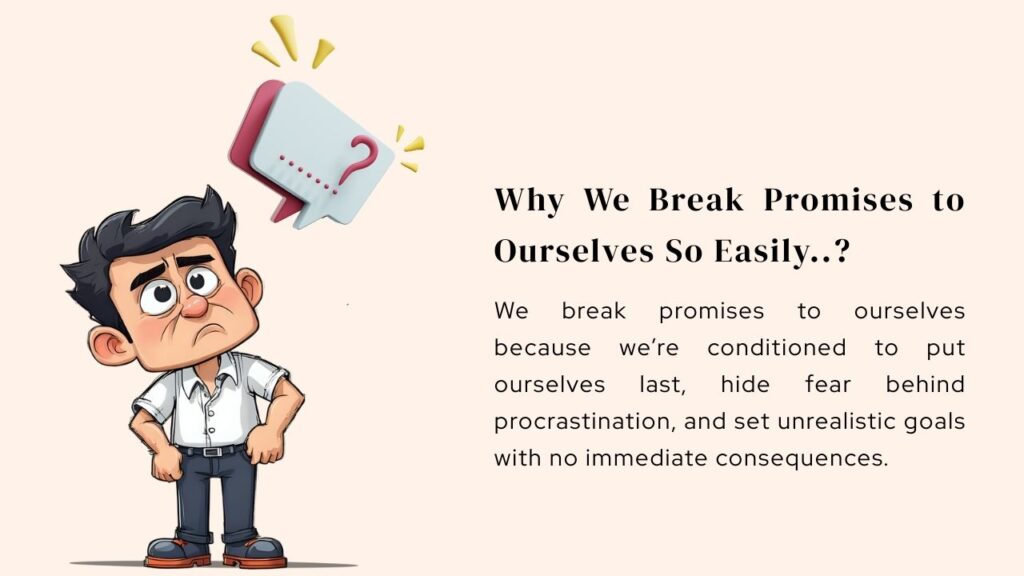
Why We Break Promises to Ourselves So Easily
If keeping commitments to yourself is so important, why do we fail at it so often?
1. We’ve been taught to put ourselves last
Many of us grow up believing that prioritizing ourselves is selfish. We’re praised for being available, helpful, and accommodating—but rarely for honoring our own needs.
Over time, this creates guilt around self-focus, even when it’s necessary.
2. Fear disguised as procrastination
Often, we don’t avoid action because we’re lazy—we avoid it because we’re afraid.
- Fear of failure. “Learn how to overcome Fear of Failure“
- Fear of judgment.
- Fear of realizing we didn’t live up to our own expectations.
Avoiding the commitment feels safer than facing the outcome.
3. We set unrealistic expectations
We promise ourselves drastic changes:
- “I’ll wake up at 5 AM every day”
- “I’ll work out for an hour daily”
- “I’ll completely change my life starting Monday”
“When the plan is too intense, the brain resists—and quitting becomes inevitable.“
4. There are no immediate consequences
Letting someone else down feels uncomfortable immediately. Letting yourself down feels quiet. Private. Easy to ignore—until it becomes a habit.
Why Keeping Commitments to Yourself Changes Everything
Every time you keep a promise to yourself, something powerful happens:
- Your confidence grows
- Your self-respect increases
- Decision-making becomes easier
- Discipline replaces motivation
- You stop relying on external validation
Self-commitment isn’t about perfection. It’s about proving to yourself that your word matters.
In many ways, keeping commitments to yourself is one of the highest forms of self-respect—and one of the purest forms of self-love.
A Mindset Shift That Makes Self-Commitment Easier
One of the biggest mistakes people make is waiting to feel motivated before taking action.
Motivation is unreliable. It comes and goes. Commitment, on the other hand, is a decision.
Instead of asking:
“Do I feel like doing this today?”
Ask:
“What kind of person do I want to be, even on hard days?”
This shift alone changes how you show up.
How to Start Keeping Commitments to Yourself (That Actually Last)
Here are practical, realistic ways to build self-commitment without burning out.
1. Protect your mindset before protecting your schedule
Your mindset determines whether you follow through.
Pay attention to:
- Negative self-talk
- Overthinking
- Doubt disguised as “being realistic”
When your mind starts working against you, pause and reset.
That might mean:
- Going for a short walk
- Listening to uplifting music
- Writing down one thing you’re grateful for
- Moving your body for 5 minutes
Small mental resets matter more than big motivational speeches.
Even trends you see on platforms like TikTok sometimes carry a useful idea underneath the noise: intentionally directing your thoughts instead of letting them spiral.
2. Make consistency automatic, not emotional
The brain loves routines. It hates decision-making.
If you rely on daily choices like when or if you’ll do something, you’ll eventually quit.
Instead:
- Do important habits at the same time every day
- Follow the same sequence
- Reduce thinking as much as possible
For example:
Wake up → drink water → change clothes → start the task
When the routine is predictable, discipline becomes automatic.
3. Lower the bar—but never skip
One of the fastest ways to break self-trust is all-or-nothing thinking.
You don’t need:
- The perfect workout
- The longest study session
- The most productive day
You need consistency, even if it’s imperfect.
Tell yourself:
- “I’ll do 10 minutes”
- “I’ll take one small step”
- “I won’t quit—just adjust”
Showing up matters more than intensity.
4. Tie your actions to your identity
Instead of focusing on outcomes, focus on who you’re becoming.
Not:
“I need to work out”
But:
“I’m someone who keeps promises to myself”
When actions align with identity, they feel less forced and more natural.
Ask yourself:
“If I respected myself, what would I do right now?”
Then do that—even if it’s uncomfortable.
When You Slip (Because You Will)
Breaking a commitment doesn’t make you weak.
Staying stuck in guilt does.
When you slip:
- Don’t shame yourself
- Don’t overanalyze
- Don’t quit
Acknowledge it. Reset. Continue.
Self-commitment is built through returning, not being perfect.
Final Thought: The Promise That Matters Most
Your life is shaped by the promises you keep—not just to others, but to yourself.
When you consistently honor your own word:
- You stop doubting yourself
- You stop waiting for permission
- You start trusting your decisions
If there’s one commitment you’ve been avoiding—start small, start imperfectly, but start today.
No one else is coming to do it for you.
And the moment you begin keeping commitments to yourself, everything else starts to fall into place.
📌 Reflection Question
What is one promise you’ve been postponing—and what’s one small step you can take today to honor it?





 and then